
 Caulk vs Sealant: Types, Differences, and How to Choose
Caulk is best for static, paintable indoor gaps, while sealant is better for waterproof, flexible, outdoor, or moving joints....
2026.07.16
Caulk vs Sealant: Types, Differences, and How to Choose
Caulk is best for static, paintable indoor gaps, while sealant is better for waterproof, flexible, outdoor, or moving joints....
2026.07.16
 What Is MS Hybrid Sealant? Features, Benefits & Uses
MS hybrid sealant is a modified silane sealant with strong adhesion, flexibility, paintability, weather resistance, low odor, and low VOC....
2026.07.14
What Is MS Hybrid Sealant? Features, Benefits & Uses
MS hybrid sealant is a modified silane sealant with strong adhesion, flexibility, paintability, weather resistance, low odor, and low VOC....
2026.07.14
 How Long Does Sealant Take to Dry? Complete Drying Times
Sealant may become touch-dry in minutes or hours, but full curing usually takes 24–72 hours or longer depending on type, bead size, and conditions....
2026.07.09
How Long Does Sealant Take to Dry? Complete Drying Times
Sealant may become touch-dry in minutes or hours, but full curing usually takes 24–72 hours or longer depending on type, bead size, and conditions....
2026.07.09
 Hybrid Polymer Sealant vs Silicone: Which Is Better?
Hybrid polymer sealant is better for paintable multi-surface bonding, while silicone is better for high-flexibility, waterproof, UV-exposed joints....
2026.07.07
Hybrid Polymer Sealant vs Silicone: Which Is Better?
Hybrid polymer sealant is better for paintable multi-surface bonding, while silicone is better for high-flexibility, waterproof, UV-exposed joints....
2026.07.07
 Hybrid Sealant Packaging: Cartridge vs Sausage – Which to Choose?
Choose cartridges for small repairs and standard caulking guns; choose sausage packages for professional use, lower waste, and higher-volume hybrid se...
2026.07.03
Hybrid Sealant Packaging: Cartridge vs Sausage – Which to Choose?
Choose cartridges for small repairs and standard caulking guns; choose sausage packages for professional use, lower waste, and higher-volume hybrid se...
2026.07.03
 How to Paint Over Silicone Sealant – Tips That Actually Work
You cannot paint directly over silicone sealant; use paintable caulk, bonding primer, or replace it with paintable sealant for a lasting finish....
2026.06.30
How to Paint Over Silicone Sealant – Tips That Actually Work
You cannot paint directly over silicone sealant; use paintable caulk, bonding primer, or replace it with paintable sealant for a lasting finish....
2026.06.30
 Is Epoxy Grout Sealer Necessary? Lab Test Findings Debunk the Myth
Epoxy grout sealer is usually unnecessary because cured epoxy grout is dense and non-porous; sealing may leave haze, peeling, or residue....
2026.06.23
Is Epoxy Grout Sealer Necessary? Lab Test Findings Debunk the Myth
Epoxy grout sealer is usually unnecessary because cured epoxy grout is dense and non-porous; sealing may leave haze, peeling, or residue....
2026.06.23
 The Complete Guide to Acrylic Latex Sealant (For Trim, Baseboards & More)
Acrylic latex sealant is a paintable, low-odor caulk for trim, baseboards, drywall gaps, and indoor joints that need a smooth finish....
2026.06.22
The Complete Guide to Acrylic Latex Sealant (For Trim, Baseboards & More)
Acrylic latex sealant is a paintable, low-odor caulk for trim, baseboards, drywall gaps, and indoor joints that need a smooth finish....
2026.06.22
 Caulk vs. Sealant: What Are the Different Types and When to Use Each
Caulk is best for dry, paintable indoor gaps, while sealant types like silicone, polyurethane, and hybrid are better for waterproof or moving joints....
2026.06.19
Caulk vs. Sealant: What Are the Different Types and When to Use Each
Caulk is best for dry, paintable indoor gaps, while sealant types like silicone, polyurethane, and hybrid are better for waterproof or moving joints....
2026.06.19
 Silicone Sealant vs. Regular Sealant: What’s the Real Difference? (Complete Guide)
Silicone sealant is one type of regular sealant, best for flexible waterproof joints; other sealants may fit paintable, structural, or indoor gaps bet...
2026.06.16
Silicone Sealant vs. Regular Sealant: What’s the Real Difference? (Complete Guide)
Silicone sealant is one type of regular sealant, best for flexible waterproof joints; other sealants may fit paintable, structural, or indoor gaps bet...
2026.06.16
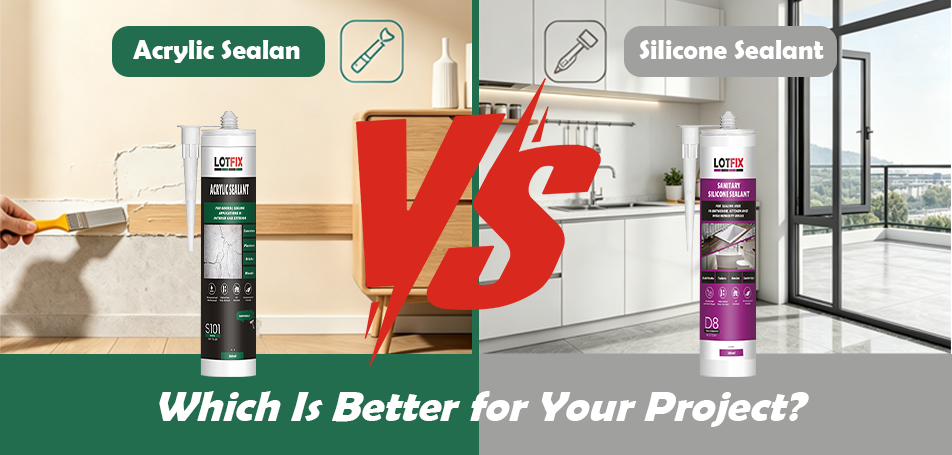 Acrylic Sealant vs Silicone Sealant: Which Is Better for Your Project?
Acrylic sealant is best for paintable indoor gaps, while silicone sealant is better for waterproof, flexible, wet-area, exterior, glass, and metal joi...
2026.06.10
Acrylic Sealant vs Silicone Sealant: Which Is Better for Your Project?
Acrylic sealant is best for paintable indoor gaps, while silicone sealant is better for waterproof, flexible, wet-area, exterior, glass, and metal joi...
2026.06.10
 Do You Need to Seal Epoxy Grout? Lab Test Results Bust the Sealer Myth
Epoxy grout usually does not need sealing because cured epoxy grout is dense and low-porosity; sealer may leave haze, residue, or add little benefit....
2026.06.09
Do You Need to Seal Epoxy Grout? Lab Test Results Bust the Sealer Myth
Epoxy grout usually does not need sealing because cured epoxy grout is dense and low-porosity; sealer may leave haze, residue, or add little benefit....
2026.06.09